
Sell class places on Shopify with seat limits and waitlists to come
A class is a group booking with a fixed start time and a seat count. Booking Slot sells each place through your normal Shopify product, counts seats in real time, and never oversells because two people clicked at once.
The problems this solves
- Two customers buy the last two bikes when there was only one
- Instructors cover for each other and the timetable goes wrong
- Members forget and turn up to the wrong session
- Class apps charge per member rather than per studio
How Booking Slot handles it
Seat-limited sessions
Set capacity per service. Seats are counted transactionally so the last place cannot be sold twice.
Instructor calendars
Each instructor has their own availability. Reassign a class to cover staff in the Calendar.
Check-in at POS
Mark attendees completed or no-show from the Calendar on any device at the door.
Per-studio pricing
Growth is £39.99 a month for 8 instructors and unlimited bookings, whatever your member count.
Choose the class preset during setup and these defaults are filled in for you.
The last bike problem
Every studio knows the moment. Twelve bikes, eleven booked, and two people are looking at the last one on their phones at the same time.
What happens next depends entirely on how the app counts seats. An app that reads the remaining count, decides there is one left, and then writes the booking has a gap between the reading and the writing, and in that gap the other customer does exactly the same thing. Both succeed. On Monday night you have thirteen people and twelve bikes, and whichever one you turn away is the one who leaves a review.
Booking Slot decrements the seat count inside a database transaction that re-checks capacity at the moment of writing. One succeeds, one is refused immediately, before checkout, and shown the next session. There is no window in which the count can go wrong, because the check and the write are the same operation.
Overselling by one is not a rounding error. It is a person standing in your studio with nowhere to go.
Sessions, start times and what shares a seat count
Seats are shared only between bookings whose start time matches exactly. A six o'clock HIIT class and a six fifteen HIIT class are two separate sessions with two separate counts, even though they use the same room and overlap.
That exactness is deliberate. Loosely matched sessions bleed into one another: someone books the later one, the app counts them against the earlier session's capacity, and your instructor ends up over the limit. An exact-match rule makes a session an unambiguous thing.
Capacity is set per service, so a twelve-bike spin class and a twenty-person bootcamp in the same studio have their own limits. Quantity in the cart works atomically, so a member booking three places for themselves and two friends either gets all three or is told there are not three left.
- Capacity per service, counted transactionally
- Seats shared only between identical start times
- Multiple seats in one cart, booked atomically
- Each session tied to one instructor who cannot be in two at once
Instructors and cover at short notice
Cover is a weekly reality in a studio and most timetable tools make it harder than it needs to be.
Each instructor in Booking Slot is a resource with their own hours and time off, and a session is tied to one of them. An instructor cannot be running two sessions at the same time, and an instructor on holiday has nothing selling that week.
When cover is arranged, reassign the session from the Calendar. The bookings, the seat count and the customers' confirmations are unaffected, because it is the same session with a different person leading it. Nobody is refunded and rebooked just to change who is at the front of the room.
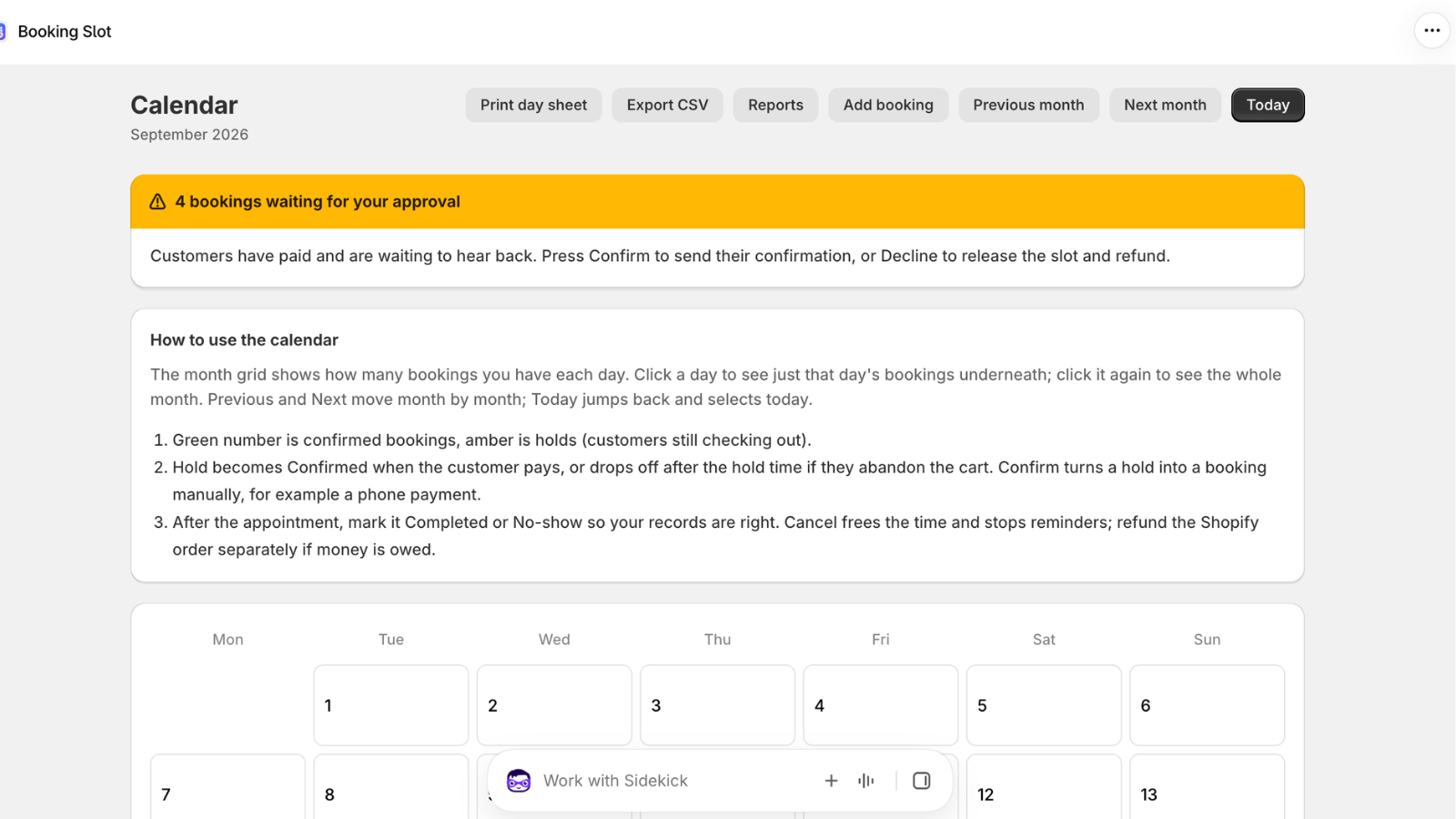
The door: attendance and check-in
The Calendar shows the attendee list for each session, which is what you want in your hand at the door rather than a printout from this morning.
Mark people attended or no-show as they arrive, from a phone or a tablet. That gives you an honest picture of which sessions fill and which quietly do not, which over a term is the information that decides your timetable.
Studios on the Growth plan can also book people in at the counter through Shopify POS, against the same seat count the website reads. Someone walking in five minutes before a class takes a real seat, not a hopeful one, and the website cannot sell it underneath them.
Per studio, not per member
Class booking platforms commonly price on your member count, which means growing your membership makes your software bill grow with it. For a studio running on thin margins that is an odd incentive.
Booking Slot charges by resources. Growth at thirty-nine ninety-nine a month covers eight instructors, unlimited bookings, group classes, booking at the counter and Google Calendar, whether your mailing list is forty people or four hundred. Pro at seventy-nine ninety-nine is unlimited resources. Annual billing takes twenty percent off.
Group classes are a Growth feature rather than a Free one, which is the honest position: a studio running a timetable is past the point a free tier is meant to serve. One-to-one personal training sessions, which are ordinary appointments, work on any plan including Free.
Questions about Shopify class booking app
Can I run a fixed weekly timetable?
Yes, though it is built from instructor hours rather than a timetable grid. Create a class service with its capacity and duration, then give the instructor hours that match when the class runs, and the picker offers exactly those start times. A Tuesday and Thursday six o'clock spin class is that instructor available six to seven on those two days, with the service set to sixty minutes. It works, and it is more fiddly than a proper timetable screen would be. That screen is on the roadmap, and this page will say so when it ships.
Do you support multi-week courses?
Not yet. A course series, where one purchase books six consecutive Tuesday sessions, is on the roadmap rather than in the product. Today you would sell the course as a Shopify product and book each session individually, which works but means more admin than it should. If your business runs mostly on blocks and terms rather than drop-ins, that is worth weighing before you install. Individual class bookings with hard capacity, instructor calendars and attendance marking are all in the product now.
Can members book several classes at once?
Yes. Each class place is a line in the cart, so a member can book Monday's spin, Wednesday's HIIT and Saturday's bootcamp in one basket and one checkout, with one confirmation covering all three. They can also book several places in the same session using quantity, which books those seats atomically: three places either all succeed or the member is told there are not three left. Every booking gets its own reminder with its own reschedule link.
Is there a waitlist when a class fills up?
Not in the current version, and it is the thing studios ask for most. Waitlists are on the roadmap alongside course series and class passes. What the app does guarantee today is that a full class is genuinely full: seats are counted inside a database transaction, so the last place cannot be sold twice and you will never have thirteen people and twelve bikes. If a waitlist is central to how you fill sessions, it is worth checking another app rather than installing on the expectation of one.
Try Booking Slot free on your store
Install in a few minutes, link one product and take a test booking. Free for one resource and 20 bookings a month, then flat pricing from £14.99.