
Group bookings with seat limits that cannot oversell
A group session is a shared start time with a seat count. Booking Slot only shares seats between customers who chose exactly the same start time, and counts them inside a transaction so the last place can never be sold twice.
The problems this solves
- Two customers buying the last seat at the same moment
- Group sessions sharing seats with a different start time by mistake
- Instructor double booked across sessions
- No way to see who is coming
How Booking Slot handles it
Hard capacity
Seats are decremented transactionally. Oversell is not possible.
Identical start only
Seats are shared only when the start time matches exactly.
Attendee list
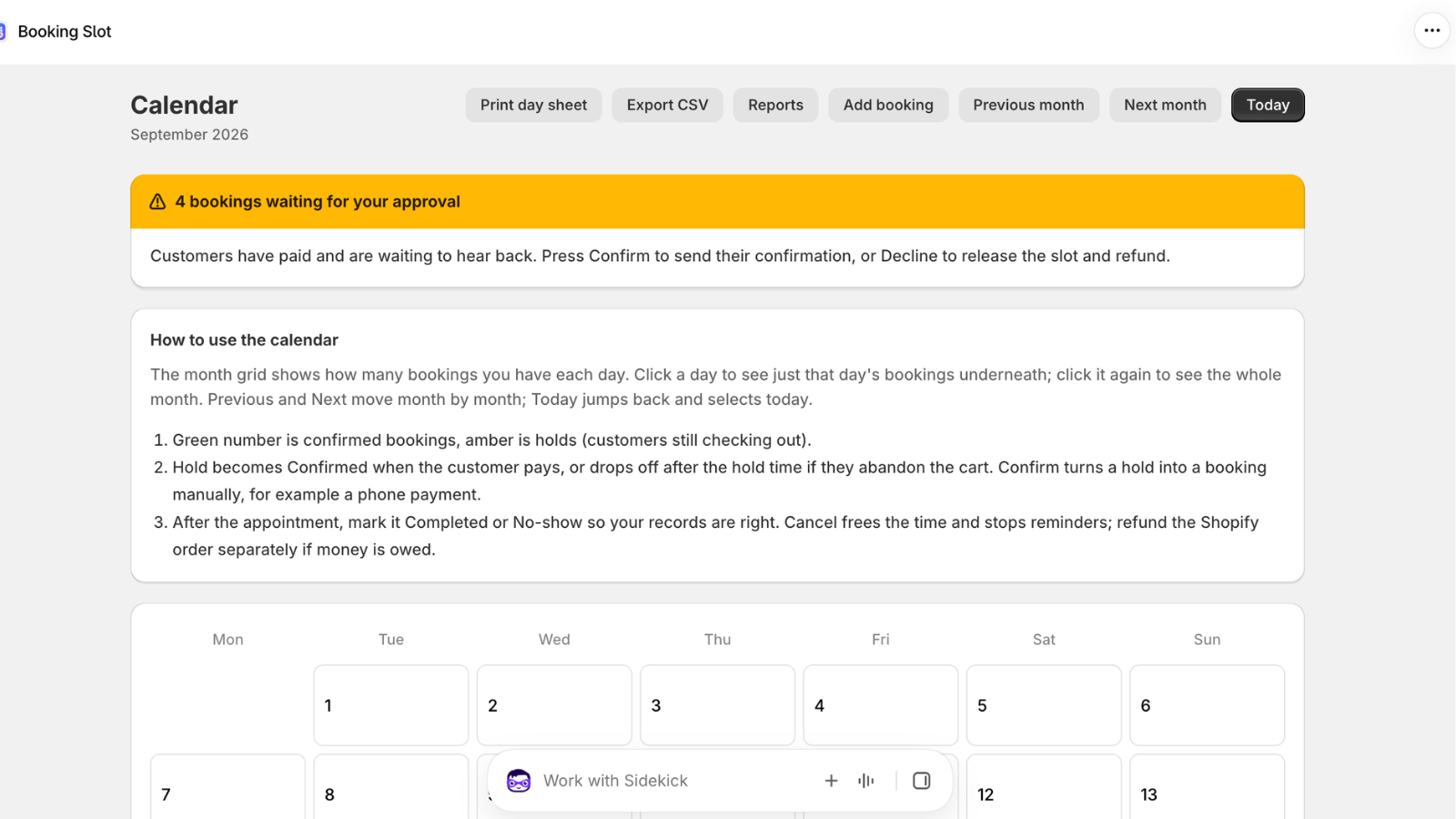
See who is booked per session in the Calendar and mark attendance.
Instructor calendar
One instructor, one session at a time.
A group booking is a different shape of problem
An appointment is exclusive. One person takes the slot and nobody else can have it. A class is the opposite: a dozen people share the same start time, and the thing being counted is seats rather than availability.
That difference is why some booking apps handle classes badly. An engine built around exclusive slots has to be persuaded to let several bookings occupy the same interval, and the persuading is usually where the bugs live. Seats get shared between sessions that merely overlap, or capacity is checked loosely enough that two people can take the last place at once.
Booking Slot treats a group session as its own kind of booking, with a capacity and a seat count that only ever decreases inside a transaction.
The last seat in a class is the one most likely to be sold twice, because that is the moment two people are both looking at it.
Identical start times only
This is a small rule that prevents a specific and confusing failure.
Seats are shared only between bookings whose start time matches exactly. A six o'clock spin class and a six fifteen spin class are two sessions with two separate seat counts, even though they overlap on the same bike, and the second one is simply not offered while the first is running.
Without that rule you get sessions bleeding into each other: someone books six fifteen, the app counts them against the six o'clock capacity, and your instructor ends up with thirteen people in a twelve-bike room. Requiring an exact match makes a session an unambiguous thing rather than a loose window.
Capacity that cannot be exceeded
Capacity is set per service, so a twelve-mat yoga class and a six-person workshop sit in the same shop without interfering with each other.
When a customer books, the seat count is decremented inside a database transaction that re-checks the remaining capacity at the moment of writing. Two people taking the last place in the same second produce exactly one success and one immediate, pre-checkout refusal. There is no window in which the count can go negative.
Quantity in the cart works the same way. A customer booking three places for themselves and two friends takes three seats atomically, or is told there are not three left.
- Capacity set per service, not per shop
- Seats decremented transactionally, never optimistically
- Quantity in the cart books that many seats at once
- Overselling is not possible, including on the last place
Instructors, cover and the attendee list
Each session is tied to an instructor, and an instructor can only lead one session at a time. Their hours and time off are respected exactly as they are for appointments, so a teacher on holiday has no classes selling that week.
When cover is arranged, reassign the session to another instructor from the Calendar. The booking records and the customers' confirmations are unaffected, because the session is the same session with a different person running it.
The Calendar shows who is booked into each session, which is what you actually want at the door. Mark people attended or no-show as they come in, from a phone or a tablet, without opening a laptop.
Setting up a timetable, and what it costs
There is no dedicated timetable view yet, so a recurring weekly class is built from the instructor's hours. Set a class service with capacity and duration, give the instructor hours that match when the class runs, and the picker offers those start times. A Tuesday and Thursday six o'clock spin class is the instructor available six to seven on those two days.
It works, and it is more fiddly than a proper timetable screen would be. That screen is on the roadmap and this page will say so when it ships.
Group bookings are on the Growth plan at thirty-nine ninety-nine a month, which also covers eight resources, booking at the till and Google Calendar. Pricing is per studio rather than per member, so a class list of four hundred costs the same as a class list of forty.
Questions about Shopify group booking
Which plan includes group bookings?
Growth at £39.99 a month and Pro at £79.99. Growth also covers eight resources, booking at the till through Shopify POS and Google Calendar for each instructor, which is the combination most studios need. Pricing is per studio rather than per member, so a class list of four hundred costs exactly the same as a list of forty, unlike the class platforms that charge on membership and make growing your audience more expensive. One-to-one sessions, which are ordinary appointments rather than group bookings, work on every plan including Free.
Can different classes have different capacities?
Yes, capacity is set per service rather than once for the whole studio. A twelve-bike spin class, a seven-mat restorative session and a twenty-person bootcamp can all run in the same shop with their own limits. That also means you can change a capacity for a specific kind of session without touching anything else, which matters when you rearrange a room or add equipment. The capacity is a hard limit, counted transactionally, so it cannot be exceeded even when two people book the last place in the same second.
Can one customer book several places at once?
Yes. Quantity in the cart books that many seats, and it happens atomically: someone booking three places for themselves and two friends either gets all three or is told there are not three left. There is no partial success where they end up with two and a confused confirmation. The Calendar shows the booking with its seat count, so at the door you know one arrival accounts for three of your twelve places.
Is there a waitlist when a class fills up?
Not yet, and it is the single most requested thing for this kind of business. Waitlists are on the roadmap, along with multi-week course series where one purchase books six sessions, and class passes or memberships. If a waitlist is essential to how you fill classes today, it is worth checking another app before installing rather than waiting on a roadmap. What is in the product is a hard capacity that cannot oversell, an attendee list for the door, and instructor calendars that respect cover and time off.
Try Booking Slot free on your store
Install in a few minutes, link one product and take a test booking. Free for one resource and 20 bookings a month, then flat pricing from £14.99.