
Tattoo consultations and sessions booked with a deposit
Studios live on deposits and artist calendars. Booking Slot lets each artist run their own days, takes a deposit at booking for long sessions, and keeps piercing walk-ins at the counter from clashing with an artist's booked afternoon.
The problems this solves
- Long sessions cancelled the night before
- Artists working different days and guest spots
- Piercing walk-ins and tattoo bookings sharing the desk
- Widgets appearing on aftercare products
How Booking Slot handles it
Artist calendars
Each artist sets their own hours and time off. Guest artists are just a resource with dates.
Deposits on long sessions
Take a deposit at booking and the balance in the studio.
Walk-ins at the counter
Book a piercing from Shopify POS against the piercer's calendar.
Picker only on bookables
Aftercare and merch products stay as normal products.
Choose the salon preset during setup and these defaults are filled in for you.
The session cancelled the night before
A full-day session is the most expensive thing a studio can lose. Six hours of an artist's time, booked weeks ahead, gone at ten o'clock the night before with no chance of refilling it.
This is why the trade runs on deposits and has done long before anyone built software for it. The deposit is not really about the money, it is about the commitment: someone who has put a hundred pounds down either turns up or gives you enough notice to do something about it.
What software should do is make the deposit automatic rather than a conversation. A client books the session on your product page, pays the deposit through checkout, and the slot is held. Nobody chases a bank transfer and nobody books a day that was never really confirmed.
A deposit is not a payment. It is the difference between a booking and an intention.
Deposits, and keeping the balance straight
Booking Slot takes the deposit as a line in your normal Shopify checkout, so the money lands in your usual payout and appears in your usual reports. No second payment provider, no separate dashboard.
The rule is set per service, as a fixed amount or a percentage. A percentage suits this trade when session prices vary widely: thirty percent of a four-hundred-pound sleeve sitting and thirty percent of a hundred-pound piece are both proportionate without you maintaining a table of thresholds. A fixed amount suits consultations and piercings.
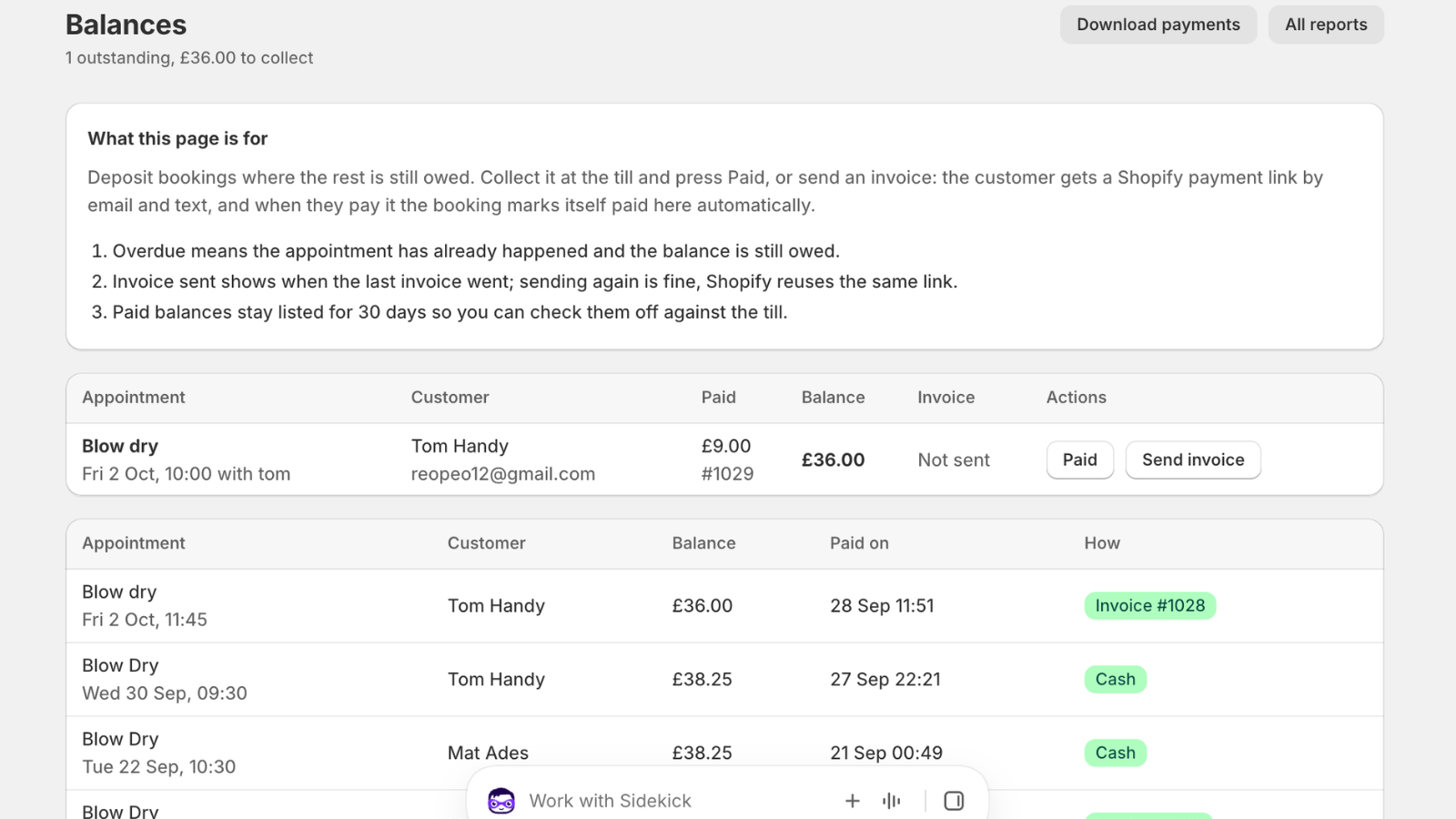
The balance is tracked on the booking. Settle it in the studio at the till when the client arrives, or send a Shopify payment link if they want to clear it beforehand. Either way it is accounted against the original order, so your week reconciles without a spreadsheet.
On non-refundable deposits, which are normal and legal in this trade: the policy is yours, stated on your own product pages and terms, and the refund itself happens in Shopify. Booking Slot does not hold the money and does not apply a cancellation policy of its own. What it does enforce is the reschedule cutoff you set, which stops a client moving Saturday's session at nine on Saturday morning.
Artists, guest spots and different working weeks
Studios rarely have everyone in on the same days, and the artists' own schedules are the thing most booking tools handle worst.
Each artist is a resource with their own hours, their own days and their own time off. One works Wednesday to Sunday, another Tuesday to Saturday with a Thursday off this week, and the picker reflects both without anyone maintaining a master rota.
A guest artist in for a fortnight is simply a resource whose hours cover those dates. Create them, give them the two weeks, link them to the services they do, and bookings open. When the dates pass, nothing more is offered. Conventions and travel are time off on that artist's record.
Services are attached to the artists who do them, so an artist who does not do fine-line or does not pierce is never offered for it.
- Per-artist hours, days and time off
- Guest artists as a resource with dated availability
- Services linked to the artists who deliver them
- Half-day and full-day sessions as separate services with their own deposits
Piercing walk-ins at the counter
A studio doing both tattooing and piercing has two very different booking patterns in the same building. Tattoo sessions are booked weeks ahead, piercings walk through the door.
Booking a walk-in piercing from Shopify POS puts it on the piercer's calendar in the same second, against the same availability the website reads. There is no sync step, so the website cannot sell that half hour underneath you, and a piercer booked at the counter for quarter past two is genuinely busy at quarter past two.
Several bookings go through one POS transaction, which covers the two friends who both want the same thing done. Booking at the counter is on the Growth plan using Shopify POS Lite or Pro.
If the connection drops, the till shows an error rather than guessing from a cached list. Less impressive, and the right behaviour: a booking created on stale data is a clash you discover with both clients in the shop.
Consultations first, and what it costs
A lot of studios want a consultation before a session is booked, and that is two bookable products rather than one. Sell the consultation as its own service, usually short and either free with approval switched on or with a small fee, and book the session itself afterwards once the design and the time are agreed. Automatically requiring one before the other is not in the product; it is handled by how you arrange the products and what your page says.
The picker renders only on the products you link to a service, so aftercare balm, merchandise and flash prints stay as ordinary products with nothing added to them.
On price: one artist runs free with twenty bookings a month. Two artists is Starter at fourteen ninety-nine, which is where deposits arrive, so most studios start there. Three to eight artists is Growth at thirty-nine ninety-nine, adding booking at the counter and Google Calendar per artist. Above eight, Pro at seventy-nine ninety-nine. Annual billing takes twenty percent off, and no tier takes a share of what you charge.
Questions about Shopify booking app tattoo studio
Can I require a consultation before someone books a session?
Not as an automatic rule, but it is straightforward to arrange with two products. Sell the consultation as its own bookable service, usually short and either free with approval switched on or with a small fee. Then book the session itself afterwards, once the design, the time and the deposit are agreed, which in most studios happens at the counter or by message anyway. Enforcing the order automatically is not in the product; what does the work is how you arrange the products and what your page says about the process.
Can deposits be non-refundable?
Yes, and that is your policy rather than something the app imposes. Booking Slot never holds the money and never applies a cancellation policy of its own: the deposit lands in your normal Shopify payout, and any refund is something you issue in Shopify under your own terms. Non-refundable deposits are normal and legal in this trade, but only enforceable if the client was told before they paid, so put it on the product page and in your terms rather than only in the confirmation email that arrives afterwards. What the app does enforce is your reschedule cutoff.
Can I offer half-day and full-day sessions?
Yes, as separate services, each with its own duration, price and deposit rule. That is usually cleaner than variants here, because the deposit on a full day is rarely proportional to the one on a half day and you may want different buffers behind them. A percentage deposit works well across a wide price range: thirty percent of a four-hundred-pound sitting and thirty percent of a hundred-pound piece are both proportionate without you maintaining a table of thresholds. Sessions can be any length, not just slots on a grid.
Can reminders include aftercare instructions?
Yes, both the confirmation and the reminder are templates you edit, so put whatever a client needs in them. Studios typically use the confirmation for preparation, eat beforehand, no alcohol the night before, bring ID, and the reminder for the practical detail on the day. For aftercare specifically, the confirmation that goes out after the session is where most studios put it. Keep the content transactional rather than promotional, since these go out under transactional messaging rules. Every message also carries a link the client can use to move or cancel within your cutoff.
Try Booking Slot free on your store
Install in a few minutes, link one product and take a test booking. Free for one resource and 20 bookings a month, then flat pricing from £14.99.